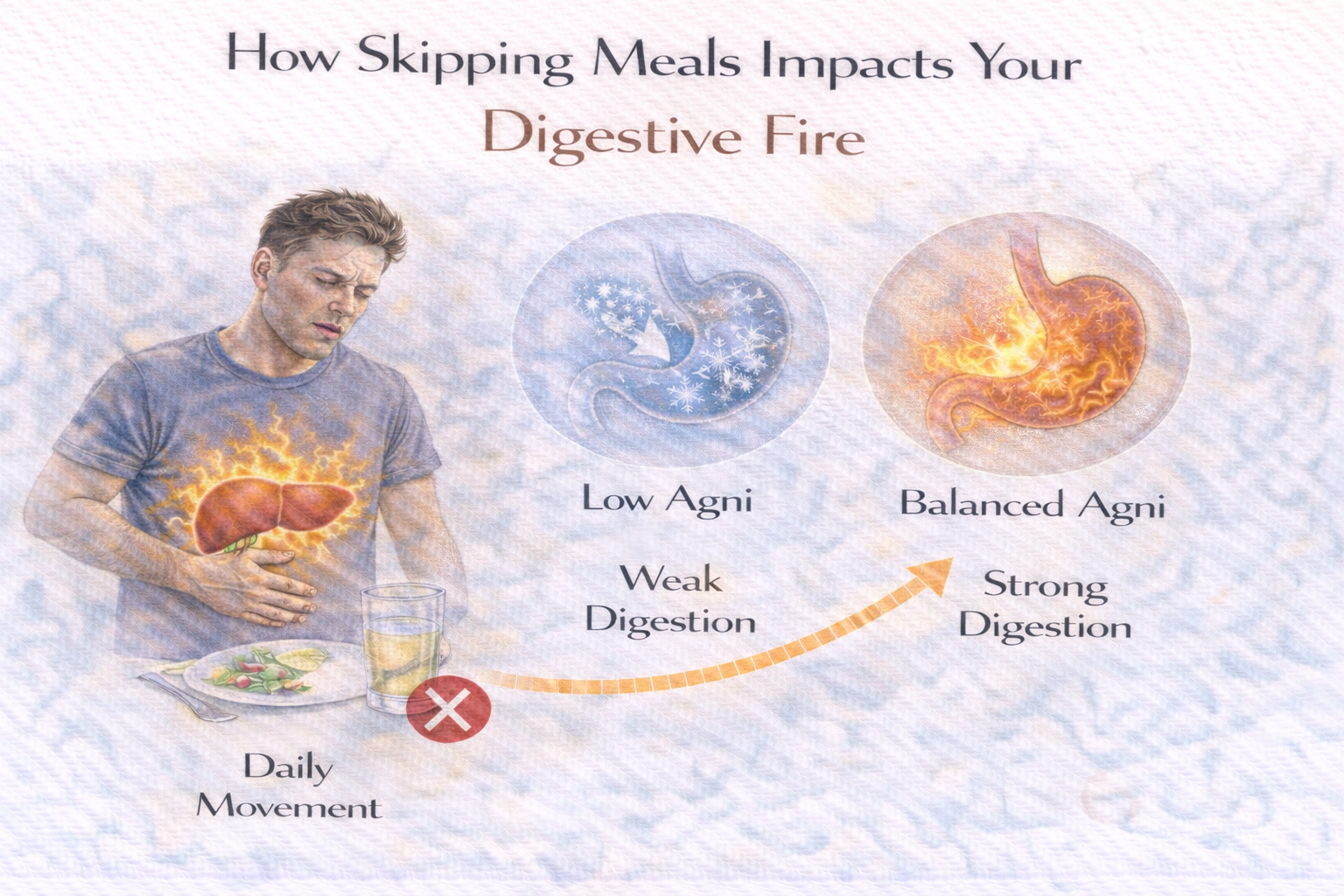
How Skipping Meals Impacts Your Digestive Fire
How Skipping Meals Impacts Your Digestive Fire
In our fast-paced world, skipping breakfast to catch a bus or working through lunch to meet a deadline has become a badge of productivity. We often think, "I’ll just eat a bigger dinner later," assuming that calories are like a bank account—it doesn't matter when you deposit them, as long as they get there.
However, in Ayurveda, the timing of your meals is everything. Your digestion is governed by Agni, or "Digestive Fire." Just like a real fire, it needs to be tended to with care. When you skip meals, you aren't just saving time; you are essentially throwing water on your internal furnace.
1. The "Cold Engine" Effect
Imagine you start a campfire to cook a meal, but you never put any wood on it. Eventually, the flames die down, leaving only cold, gray ash.
- The Problem: When your body sends a hunger signal, it has already released the enzymes and acids needed to "burn" food. If you ignore that signal and skip the meal, that fire has nothing to work on.
- The Result: The Agni becomes weak and "cold." This is why people who habitually skip meals often feel bloated or heavy when they finally do eat—their "engine" is simply too cold to start.
2. The Creation of "Acidic Smoke"
When the digestive fire is ready but there is no food to process, the acid stays in the stomach.
- The Result: This leads to Amlapitta (acidity). Think of it like a car idling for too long—it starts to create unnecessary smoke and heat.
- The Long-term Damage: This excess "mental and physical heat" can irritate the Liver and create a "burning" sensation in the gut, even if you didn't eat anything spicy.
3. The "Emergency Storage" Trap
If you skip meals regularly, your body enters "Survival Mode." It stops trusting that food will arrive on time.
- The Consequence: To protect itself, the body slows down its metabolism. The next time you eat, the Liver is instructed to store that food as fat around your organs instead of burning it for energy. This is a leading cause of feeling tired and "puffy" despite not eating much.
How to Keep Your Fire Burning Steady
- The 80% Rule: Don't wait until you are starving to eat, as that can lead to overeating and "smothering" the fire. Eat when you feel a gentle hunger, and stop when you are 80% full.
- The Clay Pot Sip: If you are forced to skip a meal due to an emergency, sip water from a clay pot. Its natural alkalinity helps soothe the "empty" acid in your stomach, preventing it from damaging your internal lining.
- The "Living" Snack: If you can't have a full meal, have something "Living" and light, like a Papaya or a few soaked Almonds. This gives the Agni just enough "wood" to stay alive without requiring a massive amount of energy to digest.
Frequently Asked Questions (FAQs)
Q1: Is Intermittent Fasting bad for my Agni?
Ans: Fasting can be healthy, but only if done correctly. If you are fasting while feeling irritable, shaky, or acidic, you are damaging your fire. True Ayurvedic fasting should make you feel light and clear-headed.
Q2: Can skipping meals affect my Kidneys?
Ans: Yes. When you skip meals, your body breaks down its own tissues for energy, creating metabolic waste. Without regular food and hydration, this waste becomes concentrated, putting extra strain on the Kidney filters.
Q3: Why do I lose my appetite after skipping lunch?
Ans: This is a sign that your Agni has "gone out." Your body has shut down the hunger signals because it realized no food was coming. Use a little Ginger and Salt before your next meal to "re-light" the fire.
Q4: Will drinking coffee instead of eating help?
Ans: No. Coffee is like throwing kerosene on an empty stove. It gives a burst of fake heat but dries out your "internal juices," leading to a massive crash and digestive weakness later.
Need Personalized Kidney Care?
Book a free consultation with our kidney specialists today.