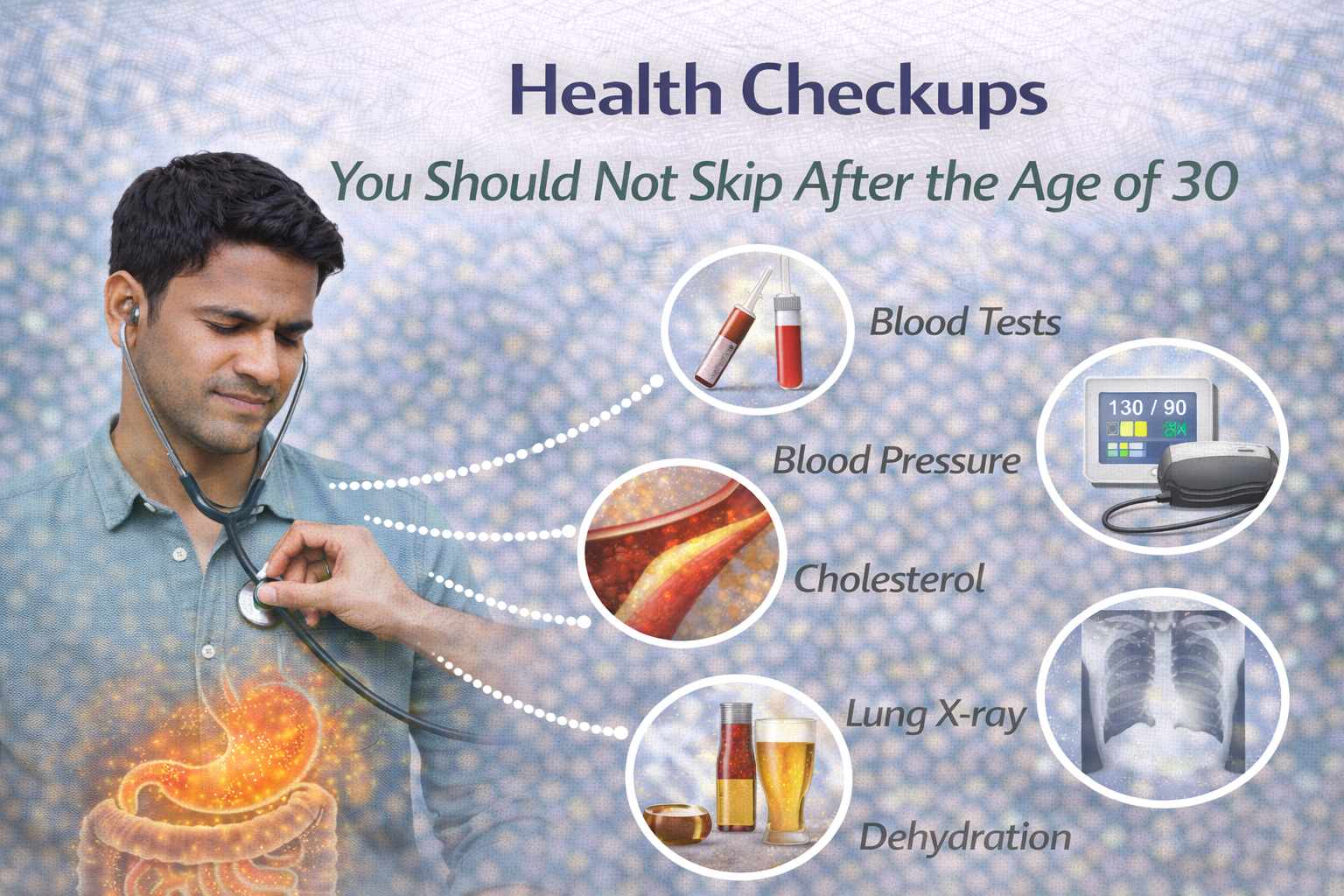
Health Checkups You Should Not Skip After the Age of 30
Health Checkups You Should Not Skip After the Age of 30
Turning 30 is a beautiful milestone. You’re likely more confident, settled, and aware of what you want in life. However, your 30s are also the decade where your body’s "warranty period" starts to shift. In your 20s, your body can usually bounce back from late nights and junk food with ease. But once you cross 30, the "silent" changes begin.
In Ayurveda, the 30s are considered a transition from the high-energy "Pitta" phase of life toward a more stable but demanding period. This is when small imbalances—if ignored—can turn into chronic issues like high blood pressure, diabetes, or kidney stress.
Think of your body like a high-performance car. After 30, you can't just drive it until it breaks; you need to start doing proactive maintenance. Here are the essential health checkups you should never skip.
1. The "Silent Filter" Check (Kidney Function Test)
Your kidneys are the master chemists of your body. They don't scream for help until they are nearly 70% damaged, which is why testing is vital.
The Tests: Serum Creatinine and eGFR (Estimated Glomerular Filtration Rate).
Why it matters: These tests tell you exactly how well your "filters" are working. High creatinine levels often mean your body is struggling to clear out waste. Checking this now allows you to make lifestyle changes—like switching to a Living Food Diet—before any permanent damage occurs.
2. The Pressure Gauge (Blood Pressure Monitoring)
High blood pressure is often called the "Silent Killer" because it has no obvious symptoms.
The Test: A simple BP reading.
Why it matters: Your kidneys are basically a bundle of tiny, delicate blood vessels. If your blood pressure is high, it acts like a "power washer" inside those delicate filters, causing them to scar. After 30, stress and salt intake often creep up, making this a top priority.
3. The Fuel Sensor (Blood Sugar / HbA1c)
Diabetes is the leading cause of kidney failure worldwide. Many people are "pre-diabetic" in their 30s without even knowing it.
The Test: HbA1c (which shows your average blood sugar over the last 3 months).
Why it matters: High sugar makes your blood "sticky" and inflammatory. It scratches the inside of your arteries and kidneys like sandpaper. Knowing your levels helps you adjust your fruit and grain intake to keep your "internal fire" (Agni) balanced.
4. The "Engine Oil" Check (Lipid Profile)
Your cholesterol levels are a direct reflection of your liver health and your metabolic strength.
The Test: Total Cholesterol, HDL (Good), and LDL (Bad) levels.
Why it matters: High levels of bad cholesterol can lead to blockages, not just in your heart, but in the arteries that feed your kidneys. If your kidneys don't get enough blood, they can't do their job of cleaning your body.
5. The Foundation Test (Vitamin D and B12)
In our modern indoor lifestyle, almost 70% of people over 30 are deficient in these two vital nutrients.
The Test: Vitamin D3 and Serum B12.
Why it matters: Vitamin D is actually a hormone that helps regulate your immune system and kidney health. B12 is essential for your nerves and energy levels. If these are low, you’ll feel "persistent fatigue" no matter how much you sleep.
A Human Reminder: Testing is Empowering, Not Scary
Many people avoid checkups because they are afraid of finding something wrong. But look at it this way: a test is just a conversation with your body. It gives you the map you need to navigate your health.
If a test shows a slight imbalance, it’s not a "failure"—it’s an opportunity. It’s your body saying, "Hey, could we eat a bit more raw fruit this month?" or "Could we try walking barefoot on the grass (Grounding) to lower our stress?"
Frequently Asked Questions (FAQs)
Q1: How often should I get these tests done?
Ans: If you are healthy and have no symptoms, a full "Body Audit" once a year is perfect. If you have a family history of diabetes or kidney issues, every 6 months is safer.
Q2: I feel perfectly fine. Do I still need to test?
Ans: Yes! Issues like high creatinine and high blood pressure don't cause pain in the early stages. The goal of testing after 30 is to find the "whispers" before they become "screams."
Q3: Can my diet affect my test results?
Ans: Absolutely. If you’ve been eating a lot of processed food or refined salt, your BP and sugar might be high. Switching to a Living Food Diet for even 2 weeks before a test can often show a visible improvement in your markers.
Q4: Why is the HbA1c test better than a regular glucose test?
Ans: A regular glucose test only shows your sugar at that exact second. The HbA1c shows the "big picture" of how you’ve been eating and managing stress for the last 90 days.
Q5: What is the most important "Ayurvedic" checkup?
Ans: Look at your tongue every morning. A thick white coating (Amma) is a daily "home test" that tells you your digestion is weak and your organs are being burdened by waste.
Need Personalized Kidney Care?
Book a free consultation with our kidney specialists today.