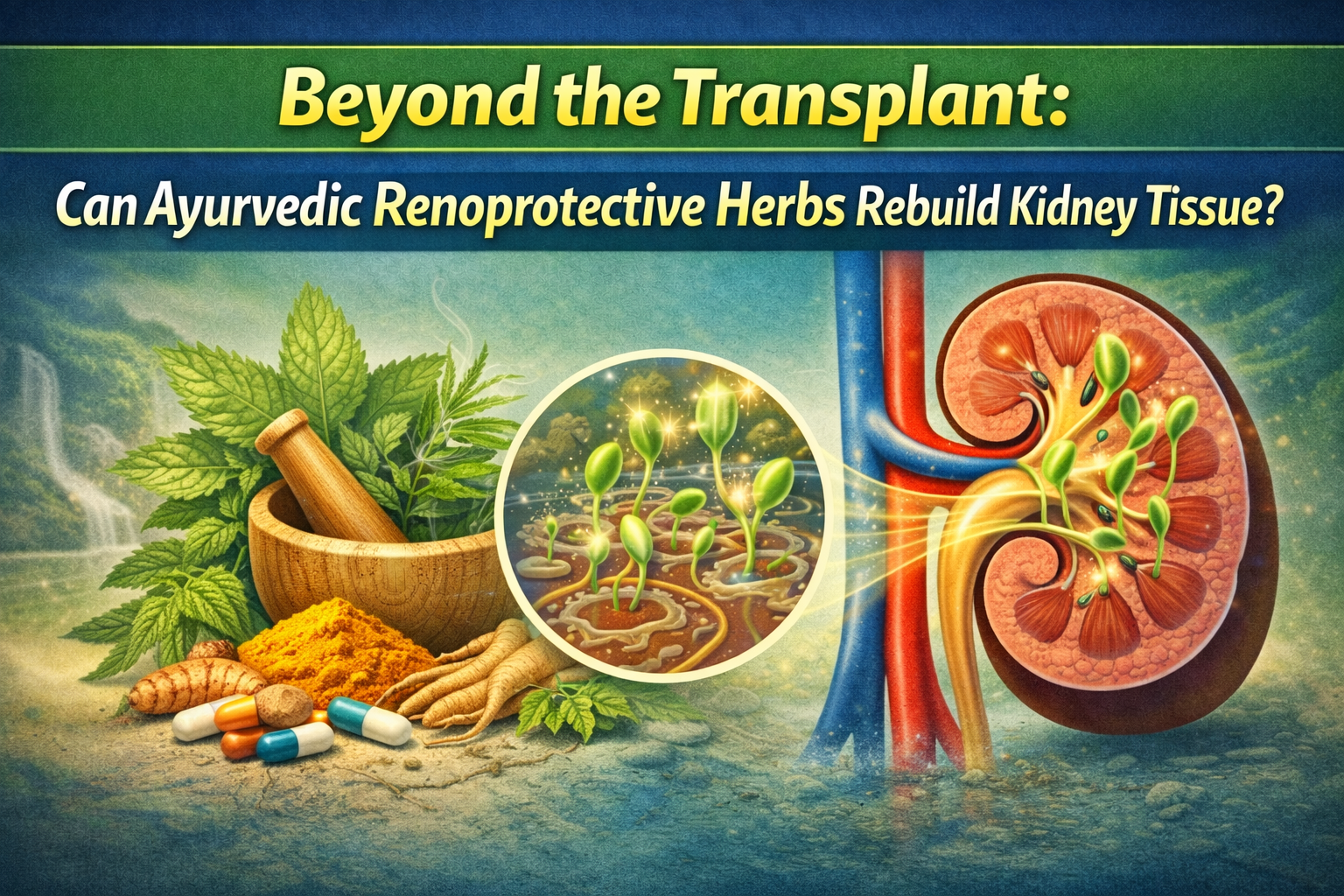
Beyond the Transplant: Can Ayurvedic Renoprotective Herbs Rebuild Kidney Tissue?
Beyond the Transplant: Can Ayurvedic Renoprotective Herbs Rebuild Kidney Tissue?
When kidney function drops to a critical level, the conversation in most hospitals quickly turns toward a transplant. It’s presented as the "ultimate fix." But for many, a transplant is a frightening and expensive road, filled with a lifetime of immunosuppressant drugs. This leads to a question that thousands of patients ask us every day: Is there another way? Can we actually repair the tissue we already have?
In the world of Ayurveda, we use a specific term for herbs that protect and heal the kidneys: Renoprotective. While modern science often says that kidney scarring is permanent, the ancient wisdom of Rasayana (Rejuvenation) suggests that we can "wake up" the dormant parts of your kidneys and protect the healthy cells from dying.
The "Dormant" Nephron Theory
Think of your kidney as a large factory with 1 million tiny workers (nephrons). When you have kidney disease, it doesn't mean all 1 million workers are "dead."
Some are truly scarred.
Many are just "exhausted" and have gone on strike because of too much acid, sugar, or high blood pressure.
Others are "sick" but still breathing.
A transplant replaces the entire factory. Renoprotective herbs, however, are like a specialized medical team that enters the old factory to heal the sick workers and give the exhausted ones the "nutrition" they need to start working again.
The Powerhouse Herbs: Your Natural Repair Crew
There are three specific herbs that act as the backbone of kidney tissue protection:
Punarnava (The Regenerator): As we’ve discussed before, its name literally means "New Again." It reduces the "interstitial edema" (swelling inside the kidney tissue). By removing this internal pressure, the kidney cells get more oxygen and can start to repair themselves.
Gokshura (The Shield): This herb is rich in natural alkaloids that act as a shield for the delicate "basement membrane" of the kidney filters. It prevents further scarring (fibrosis), which is the biggest enemy of kidney health.
Varun (The De-Clogger): Often, kidney tissue is "crushed" because the tiny tubes are blocked with waste. Varun acts like a natural drain cleaner, clearing out the debris so the tissue can breathe and "flow" again.
The "Soil" and the "Plant"
Imagine a plant that is withering because the soil is salty and dry. You could replace the plant (Transplant), but if you put a new plant in that same bad soil, it will eventually wither too.
Ayurvedic herbs work on the soil (your blood and internal environment). By alkalizing your blood and removing "Amma" (toxins), these herbs create an environment where your existing kidney tissue doesn't have to die. When the environment is clean, the body’s natural intelligence—the same intelligence that healed your scraped knee as a child—can start repairing the kidney tissue.
A Human Reminder: Hope is a Strategy
A transplant is a miracle of modern surgery, but it doesn't have to be the only story. Many patients have seen their GFR (filtration rate) improve and their creatinine stabilize just by giving their kidneys the right herbal support and a clean, alkaline diet.
Before you think you are "out of options," remember that your body is a living, breathing system, not a machine with broken parts. With the right Renoprotective herbs, you can give your kidneys a fighting chance to rebuild.
"The best replacement for a kidney isn't a new one; it's the one you were born with, healed and protected."
Frequently Asked Questions (FAQs)
Q1: Can these herbs reverse "End-Stage" scarring?
Ans: Total scarring (fibrosis) is very difficult to reverse, but most patients have "partially damaged" tissue that can be significantly improved, helping them avoid or delay dialysis.
Q2: Will these herbs interfere with my current medications?
Ans: Most Renoprotective herbs are gentle, but because they improve kidney function, you may need to reduce your BP or sugar meds over time. Always work with an expert.
Q3: How long do I need to take these herbs to see "tissue" improvement?
Ans: Tissue healing is a slow process. While symptoms (like swelling) improve in weeks, real "renoprotective" changes usually show up in lab reports after 3 to 6 months of consistent use.
Need Personalized Kidney Care?
Book a free consultation with our kidney specialists today.