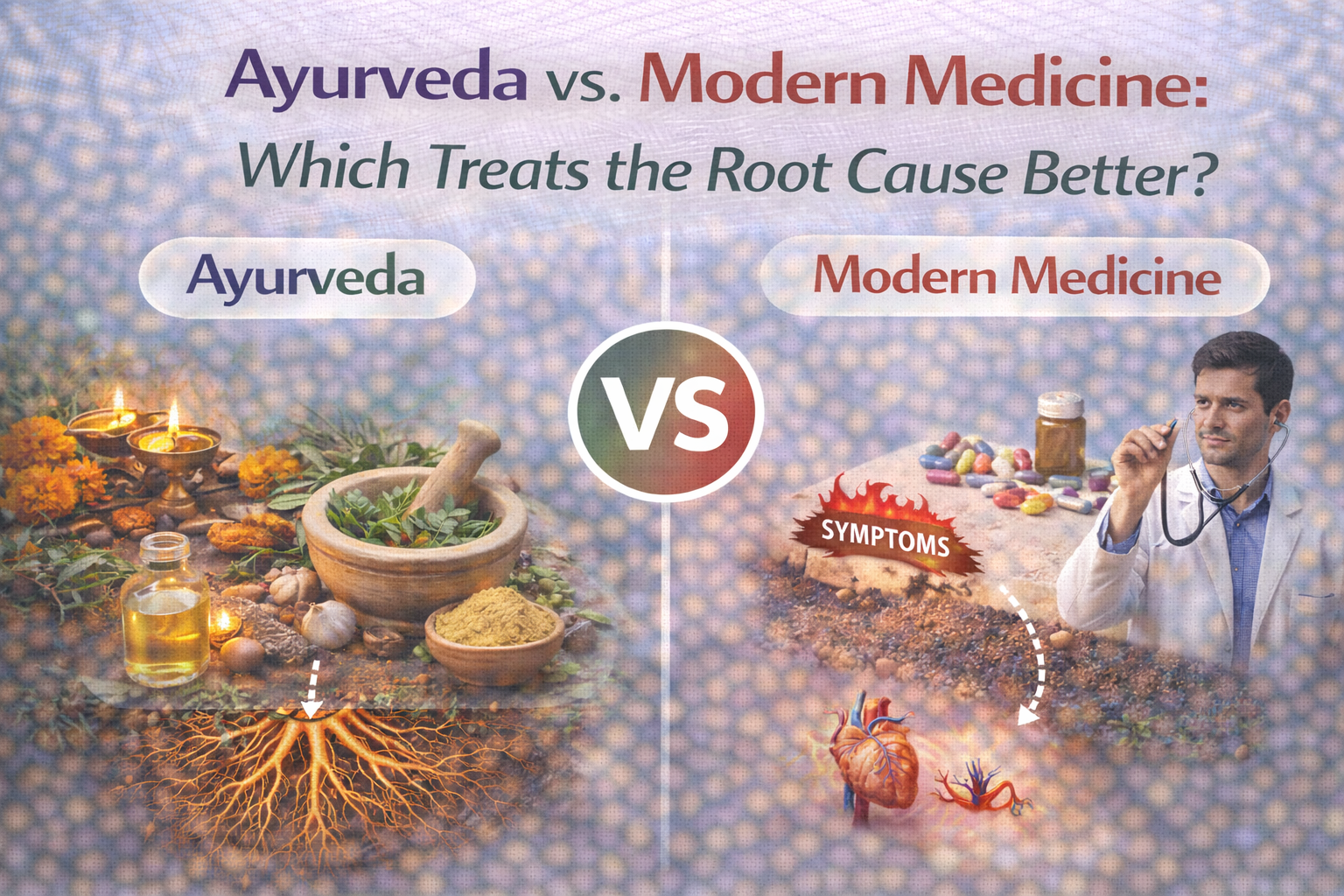
Ayurveda vs. Modern Medicine: Which Treats the Root Cause Better?
Ayurveda vs. Modern Medicine: Which Treats the Root Cause Better?
If you walk into a doctor’s office with a pounding headache, you’ll likely walk out with a prescription for a painkiller. Within twenty minutes, the pain is gone. That is the "magic" of modern medicine. It is fast, efficient, and incredible in an emergency.
But if that headache comes back every single afternoon for three years, you start to wonder: Why is this happening in the first place? This is where the great debate begins. Modern medicine and Ayurveda are like two different lenses on a telescope. One looks at the microscopic details of the "now," while the other looks at the vast landscape of "how we got here." To understand which treats the "root cause" better, we have to look at how they define a problem.
Modern Medicine: The Specialist of "What"
Modern medicine (Allopathy) is built on crisis management. It is brilliant at identifying what is happening. It uses blood tests, MRIs, and biopsies to pinpoint exactly which part of the machine is broken.
- The Strength: If you have a high-grade fever, a broken bone, or an acute kidney infection, you want modern medicine. It steps in to save your life by stopping the symptom before it kills you.
- The Limitation: It often treats the body like a collection of separate parts. If your kidneys are struggling, you see a nephrologist. If your skin is breaking out, you see a dermatologist. But often, the skin is breaking out because the kidneys aren't filtering properly. By treating the skin with a cream, you’ve hidden the symptom, but the "root" (the kidney struggle) remains.
Ayurveda: The Specialist of "Why"
Ayurveda doesn't see you as a collection of parts; it sees you as an ecosystem. It isn't interested in just the headache; it’s interested in your sleep, your digestion, your stress, and even the weather outside.
- The Strength: Ayurveda looks for the "Amma" (Toxins). It believes that almost all chronic disease—whether it’s diabetes or kidney decline—starts with poor digestion and accumulated waste. By the time a disease shows up on a blood test, Ayurveda believes it has been "brewing" in your system for years.
- The "Root" Approach: Instead of just giving you a pill for blood pressure, Ayurveda asks: Is your blood thick with toxins? Are your kidneys stressed by too much salt? Is your nervous system stuck in "fight or flight"? By fixing the diet (Living Foods), the routine (Dinacharya), and the mental state, Ayurveda aims to make the "root" healthy again so the disease simply has no soil to grow in.
A Human Reality: We Need Both
The truth that most people miss is that this shouldn't be a competition. It’s about timing.
If your house is on fire, you don't want someone to explain why the electrical wiring was faulty (Ayurveda); you want a fire extinguisher (Modern Medicine). But once the fire is out, if you don't fix the wiring, the house will just burn down again.
Ayurveda treats the "Root Cause" better for chronic issues. It is unparalleled for reversing lifestyle diseases like fatty liver, early-stage kidney dysfunction, and digestive disorders because it forces you to change the environment that created the sickness.
Frequently Asked Questions (FAQs)
Q1: Can Ayurveda work for emergency situations?
Ans: Generally, no. For acute trauma, heart attacks, or severe infections, modern medicine is the gold standard. Ayurveda is "Slow Medicine"—it is best for long-term healing and prevention.
Q2: Is it okay to take Ayurvedic herbs while on Allopathic medicine?
Ans: Many people do, and it can be very effective. However, some herbs can change how your body absorbs pills. Always keep a gap of at least 90 minutes between them and keep your healthcare provider informed.
Q3: Why does Ayurveda take so long to show results?
Ans: It doesn't actually take "long"; it’s just doing a deeper job. A painkiller masks pain in minutes. Ayurveda has to clean your blood, balance your hormones, and repair your gut. That process takes time—usually 3 to 6 months for a real shift.
Q4: Does "Root Cause" mean I can stop my BP or sugar pills?
Ans: The goal of Ayurveda is to get your body so healthy that you no longer need the pills. However, you should only taper off medication with your doctor’s supervision once your test results (like HbA1c or Creatinine) show you are stable.
Q5: Which one is better for Kidney health?
Ans: For maintaining and improving kidney function, Ayurveda is often superior because it focuses on reducing the "toxic load" and managing blood pressure through diet and Grounding, rather than just adding more chemical drugs for the kidneys to filter.
Need Personalized Kidney Care?
Book a free consultation with our kidney specialists today.